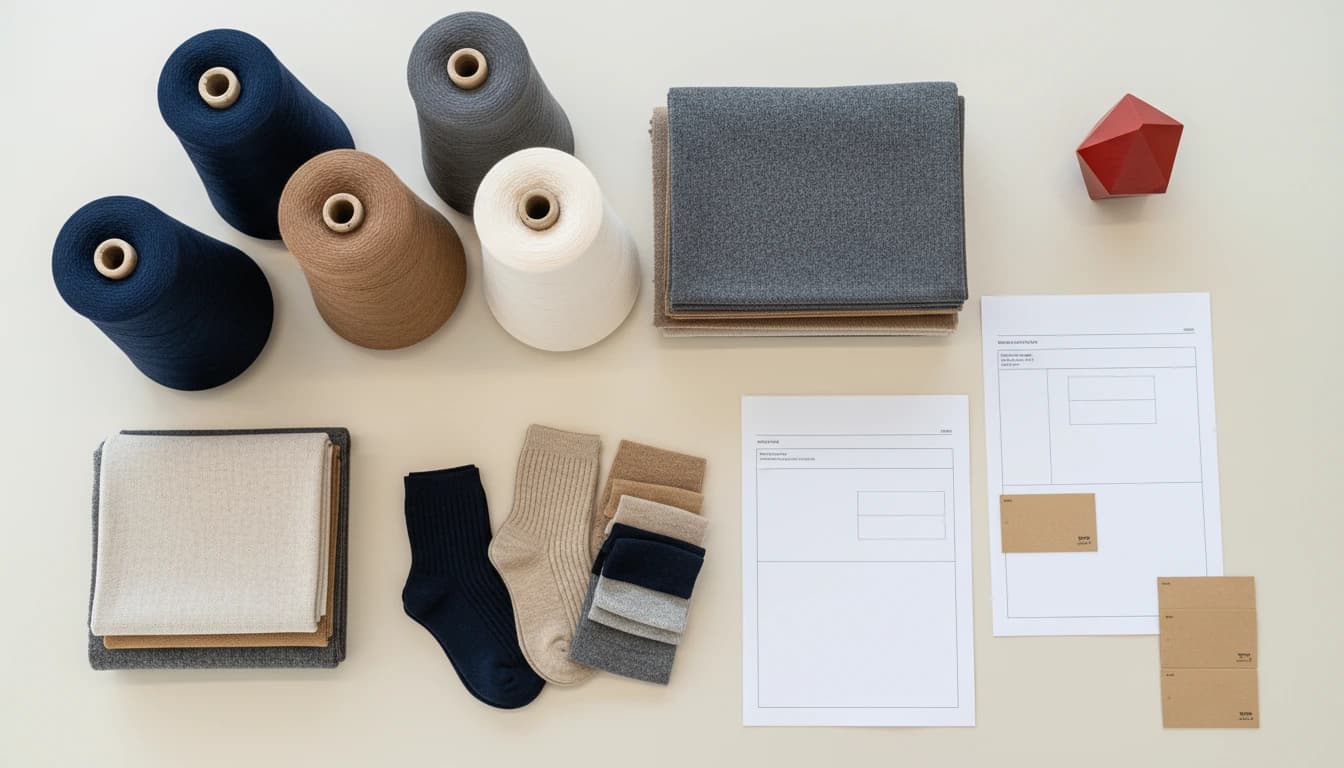
Does MOQ mean the whole order or each variant?
Ask the supplier to state what its minimum covers before comparing numbers. A minimum per design is different from a minimum per design and size. Packaging may also have a separate quantity requirement.
List each design, color and size combination with its planned pair count. If the mix is undecided, provide a working split and identify what can change rather than waiting for a final assortment.
A quantity-split example, not a quoted minimum
For illustration, 600 pairs divided evenly across three designs and two sizes leaves 100 pairs in each design-size combination. The same 600 pairs in one design and two sizes leaves 300 pairs per combination. Neither example is a SaySock MOQ or an acceptance promise.
Use the split to ask whether combining designs, reducing colorways or changing the size mix would make the proposed run more workable. Keep sizes that your buyers need; simplifying an assortment is not useful if it creates the wrong product.
What can change the workable minimum?
Common yarn bases may be easier to source than specialty fibers, but the workable minimum still depends on the full construction and current production review.
If the first-run quantity is constrained, ask which material directions are available for that specific product and packaging scope.
Check sock and packaging quantities separately
Custom boxes, sleeves, labels and inserts add their own artwork and pack-out decisions. Ask whether their quantities can match the sock order, and whether any unused packaging would remain. Do not assume the sock and packaging minimums are the same.
A shared packaging format can simplify a first run, but it does not automatically lower the sock MOQ. Compare it with your intended retail display, labeling needs and destination before deciding.
- Common yarn bases may give the review more flexibility.
- Specialty fibers can add sourcing and setup constraints.
- More colorways, sizes, or packaging variants divide the quantity.
- A shared pack-out and tighter palette can simplify the first run.
What to include in an MOQ enquiry
Send the first-run quantity range, design-size split, material direction and packaging preference. Mark fixed requirements and flexible choices separately. Undecided details are welcome; these are useful discussion inputs, not extra submission requirements.