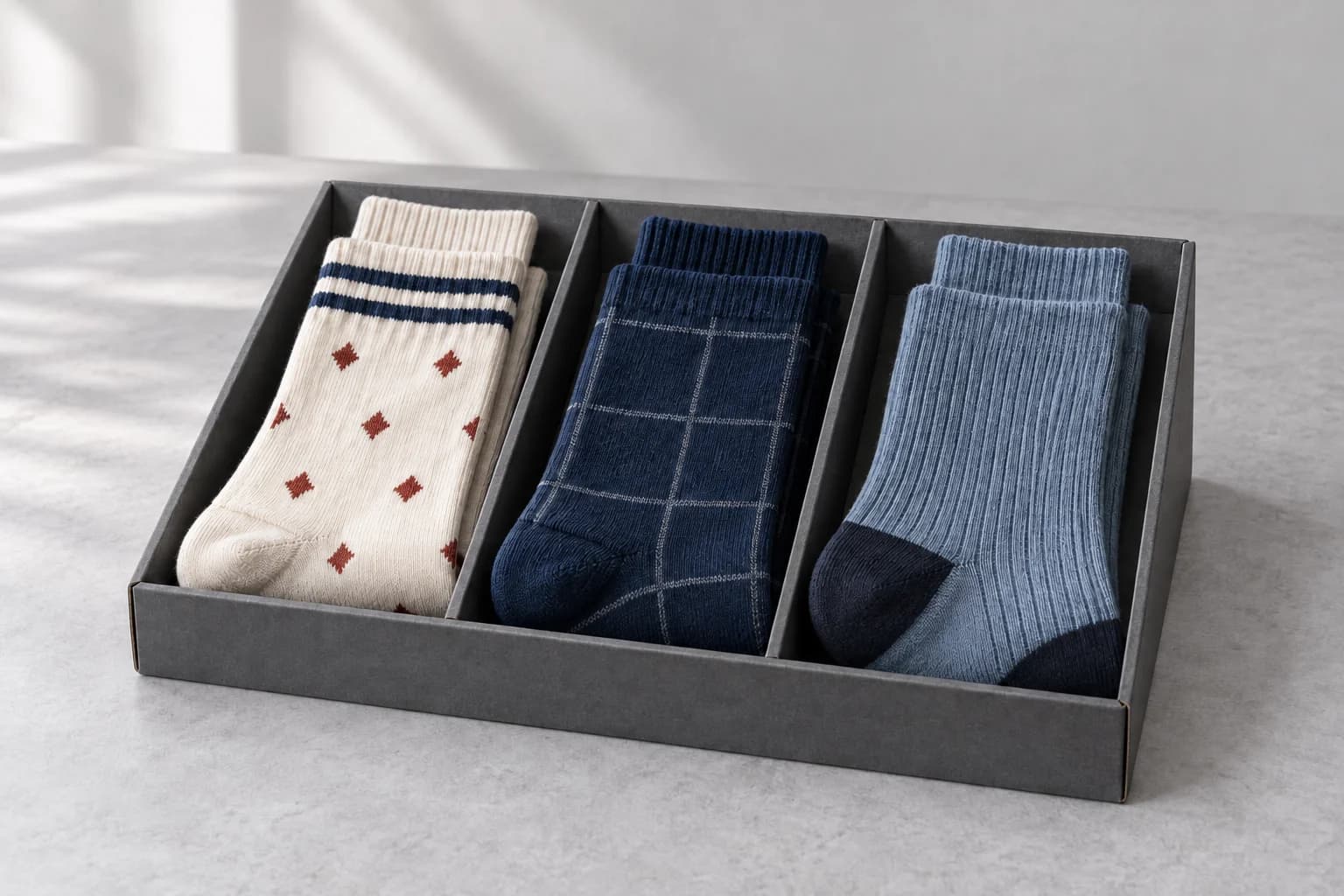
Boutique retail landing
Boutique retail socks for small assortments that need shelf-ready product discipline.
Boutique retail sock programs cannot rely on novelty alone. The product has to feel intentional on shelf, the packaging has to clarify value, and the assortment needs enough discipline to avoid looking like loose merch.

The strongest retail route aligns product family, material feel, packaging architecture, and display behavior before the first approval loop gets expensive.
Ask for a production review before every detail is final.
A useful first inquiry does not need a finished tech pack. If the buyer can state the product type, quantity band, target market, timing pressure, and packaging direction, SaySock can start the production review and narrow the missing points.
- Use a rough quantity band instead of waiting for a final PO.
- Name the channel: retail, private label, gifting, promo, or wholesale.
- Say whether packaging is bulk-clean, wrapped, tagged, boxed, or still open.
Fast RFQ path
Move from comparison to a production review in one step.
Send the available commercial frame now. Artwork files, final carton logic, and program-specific documentation can follow when they affect the first reply.
Use this route when the buyer can explain the program shape, even if the pack is unfinished.
SaySock should not read as enterprise-only. A first serious run, private-label or OEM brief, distributor repeat path, promotional campaign, or larger repeat program can all start when the commercial frame is visible.
- First serious runs are valid when product, quantity band, market, timing, and destination are clear.
- Repeat and bulk context helps when SKU count, carton logic, or documentation pressure may affect the reply.
- Promotional and gifting programs should name audience, deadline, packaging level, and delivery context.
What does not need to be final
Rough commercial frame is enough for the first production review.
Files are optional at first. Final artwork, exact carton counts, label copy, and documentation packets can follow when they clarify the review. The RFQ should separate confirmed inputs from open questions instead of waiting for a perfect tech pack.
Send rough commercial frameProgram board
Lock the channel, quantity band, and packaging shape before the first quote.
Boutique retail sock program support for design stores, museum shops, hospitality retail, and private-label buyers that need finished product, packaging, and assortment logic.
Use this route when the sock must behave like a retail product, not a giveaway.
Boutique and design-led buyers need the sock, wrap, tag, and color logic to read as one product system at shelf scale.
The first boutique brief should include shelf behavior, not only artwork.
A retail-ready inquiry needs product family, price position, packaging role, display assumptions, and variation count before the factory can recommend a sensible sample path.
A smaller retail launch works better when every SKU has a reason to exist.
Boutique retail value usually comes from restraint: fewer styles, cleaner material direction, stronger packaging logic, and product decisions that support display.
Boutique retail sock route
Use boutique retail socks when shelf behavior, packaging, material feel, and a narrow first assortment matter.
- Decide whether the first range should prove price position, packaging, and assortment logic before adding more styles.
- Bring first assortment, target channel, material direction, packaging format, quantity band, destination, and launch timing into the boutique RFQ.
- Keep product family, channel, material, packaging, sample path, destination, and RFQ evidence inside the same production inquiry.
Program fit
Use this as a reviewable custom sock program, not a loose catalog choice.
SaySock keeps each commercial program tied to buyer intent, pack-out pressure, sampling assumptions, destination context, and the evidence needed for a useful first production reply.
Send program evidenceWhat this helps you state in an RFQ
Boutique retail sock program for small shelf-ready assortments with product, packaging, and assortment logic.
- State this as a buyer-channel request before pricing is discussed.
- Use the buyer boundary: small shelf-ready assortments.
- Separate this request from adjacent product paths such as Use private-label socks for fuller product systems, Review packaging options for boutique shelves, Compare material choices before retail sampling.
RFQ boundary
Keep the first production reply specific.
Keep this page focused on small shelf-ready assortments, so the RFQ does not blur into nearby product, channel, or operating-model questions.
Bring the clearer statement into the RFQ.
Bring small shelf-ready assortments, quantity band, packaging expectation, target channel, and deadline into the RFQ.
Program fit check
small shelf-ready assortments
Boutique retail sock program for small shelf-ready assortments with product, packaging, and assortment logic.
Use private-label socks for fuller product systems
Private-label routes fit buyers who need packaging, label content, and replenishment logic.
Use private-label socks for fuller product systemsReview packaging options for boutique shelves
Boutique assortments need packaging that sells without hiding the product.
Review packaging options for boutique shelvesCompare material choices before retail sampling
Material direction affects hand feel, price position, and buyer perception.
Compare material choices before retail samplingBoutique retail socks need shelf behavior, not just attractive samples.
A boutique route should explain how the sock looks as a finished product on a shelf, wall, counter, or small assortment table.
- Design stores, museum shops, hospitality retail, and small private-label ranges
- Buyers who need fewer SKUs with stronger presentation discipline
- Retail programs where packaging and display context affect perceived value
Production lens
Make the program specific before the first quote gets too broad.
Design the first range narrowly
Boutique launches usually work better with fewer styles that have a clear reason to exist.
Make packaging do retail work
Hang tags, sleeves, wraps, or boxes should help price, display, and handle the product.
Think in refresh logic
A strong boutique system can refresh color, theme, or artwork without changing every production rule.
Curated range vs. SKU sprawl
Boutique retail value comes from focus. Too many early variants can make the range look less intentional and harder to approve.
RFQ evidence
Send the inputs that make this program ready for a production reply.
- Retail environment and expected price position
- First assortment size and SKU logic
- Display or packaging format
- Label, barcode, or carton assumptions
Buyer fit
Use this route when the sock must behave like a retail product, not a giveaway.
Boutique and design-led buyers need the sock, wrap, tag, and color logic to read as one product system at shelf scale.
Design and museum shops
Good fit when the product has to feel curated and finished without drifting into overdesigned packaging.
Hospitality retail
Useful when the product belongs inside a hotel, resort, studio, or destination retail environment.
Private-label micro assortments
Strong when the buyer wants a narrow first range that can later repeat or expand with discipline.
Retail brief
The first boutique brief should include shelf behavior, not only artwork.
A retail-ready inquiry needs product family, price position, packaging role, display assumptions, and variation count before the factory can recommend a sensible sample path.
- State the retail environment, expected price position, and first assortment size
- Clarify whether packaging is a sleeve, band, hang tag, carton, or mixed system
- Keep colorways and sizes narrow enough for a first shelf-ready launch
- Name any barcode, label, or carton assumptions before sampling is treated as final
Assortment discipline
A smaller retail launch works better when every SKU has a reason to exist.
Boutique retail value usually comes from restraint: fewer styles, cleaner material direction, stronger packaging logic, and product decisions that support display.
Narrow first range
Start with the smallest assortment that can prove the product and packaging system before expanding.
Packaging clarity
Wraps, tags, and cartons should improve perceived value and handling, not simply add decoration.
Repeatable refresh logic
Seasonal or editorial updates are easier when the base product and packaging rules are stable.
Weak fit
Boutique retail is weaker when the buyer only needs event merch.
If the product does not need shelf behavior, price position, or packaging depth, the promotional or custom logo route may be cleaner than overbuilding a retail program.
- Weak fit for short-lived event giveaways
- Weak fit when packaging has no role in the sales environment
- Weak fit when every SKU is still exploratory and the first range has no hierarchy
Frequently asked questions
Clear the keyword-level objections before the buyer leaves the page.
What makes boutique retail socks different from ordinary merch socks?
Retail socks need clearer shelf behavior, packaging, price-position, and assortment logic. The product has to sell as a finished item, not just carry a logo.
Should a boutique retail launch start with many SKUs?
Usually no. A narrower first range with stronger material and packaging logic is often easier to sample, approve, and repeat.
Can boutique socks use private-label packaging?
Yes. Private-label wraps, tags, sleeves, or cartons should be scoped early because packaging affects presentation, approval timing, and carton planning.
Need a concrete next step?