Logo-led programsPlan the logo as part of the finished product
Treat custom logo socks as a sellable product category where artwork, fit, material, packaging, and approval choices stay connected.
One logo crew sock: retail range or campaign order?
Suppose your team wants a crew sock with its logo, either for a shop range or a campaign. Here is how we could work through the same idea with you. This is a planning example, not a quoted order or a customer case.
What stays the same across both orders?
A choice to discuss
Start from one agreed crew-sock specification and logo version. In this example, the retail and campaign pairs share the same construction, colors and mark; the packaging and delivery brief differ. A change of sales channel does not itself require a different logo.
What the sample or brief should resolve
If artwork is still open, use the logo-readability examples below to discuss which version to sample. Keep the approved sock specification and artwork revision with both quote briefs. A new logo, yarn or construction needs review rather than being treated as the same approved sample.
For a shop: a paper band or a hang tag?
A choice to discuss
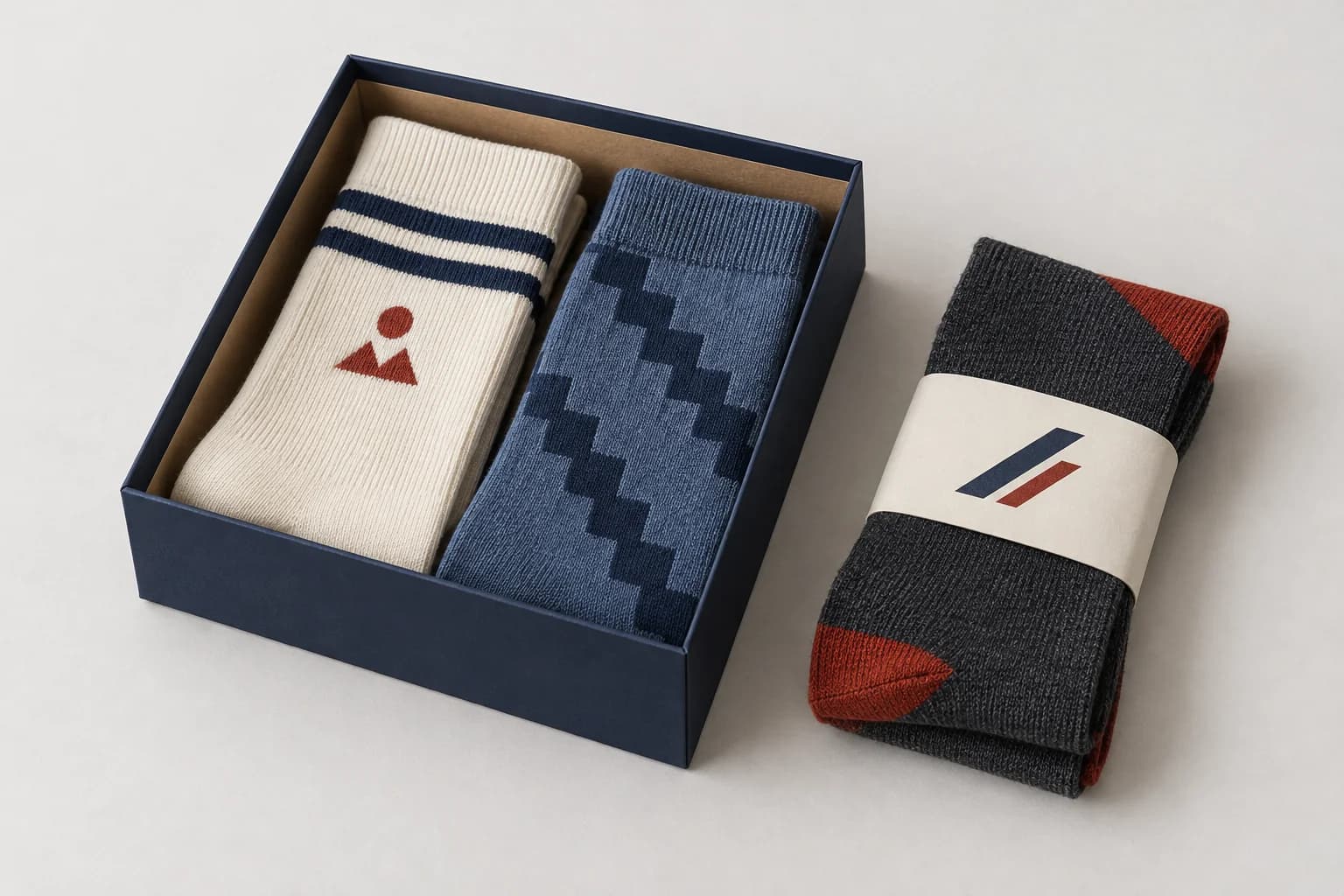
A paper band around a folded pair and a hang tag are two starting options. Consider which leaves the logo visible and fits your display. A retail own-brand program can combine the same logo sock with your label and packaging.
What the sample or brief should resolve
Review a packed pair for logo visibility, size identification, how the socks stay together and any buyer-supplied barcode or label text. Confirm who supplies the artwork and which packaging version belongs in the quote; market-specific label requirements still need review.
For a campaign: bulk distribution or individual gifts?
A choice to discuss
Use the same sock idea, but discuss whether pairs will be handed out from cartons or packed individually for a gift kit. A retail-style band or gift box is not automatically needed for a bulk order.
What the sample or brief should resolve
State the approximate pairs and size split if known, how pairs should be grouped, the delivery destination and the date you are working toward. If a kit or individual pack is needed, include its dimensions and assembly questions. Packaging, quantity and timing can stay open for the first discussion.
Start with a logo idea or an existing specification. We can help work through the open choices, reviewing direct Korean production first. You do not need final artwork, a settled quantity or chosen packaging to inquire; feasibility, MOQ, pricing and timing are confirmed separately.
Ordering socks for staff, an event and partners? Separate what you want to produce from how the pairs will be grouped. Three recipient groups do not automatically mean three sock designs.
Mark a preferred position on your reference: the leg, cuff or foot. Placement, scale and knit readability need review for the chosen sock. You can leave this undecided when you inquire.
Want to sketch a direction? Try the free sock mockup tool. It is optional; you can also bring an idea or your existing specification. We can help review what will work on the sock.
Small logo, full name or subtle mark?
Start with the brand detail you want people to recognize. We can help compare a simpler mark, a larger placement or a different contrast before you choose what to sample.
A full name with a tagline
Direction to compare
Keep the name on the sock, or use the main symbol and carry the tagline on a paper band or tag. You do not have to fit every brand detail into the knit.
Sample question
At the proposed size, can the letters and the spaces inside them still be distinguished? Compare the versions on the same sock construction.
Small initials or a compact symbol
Direction to compare
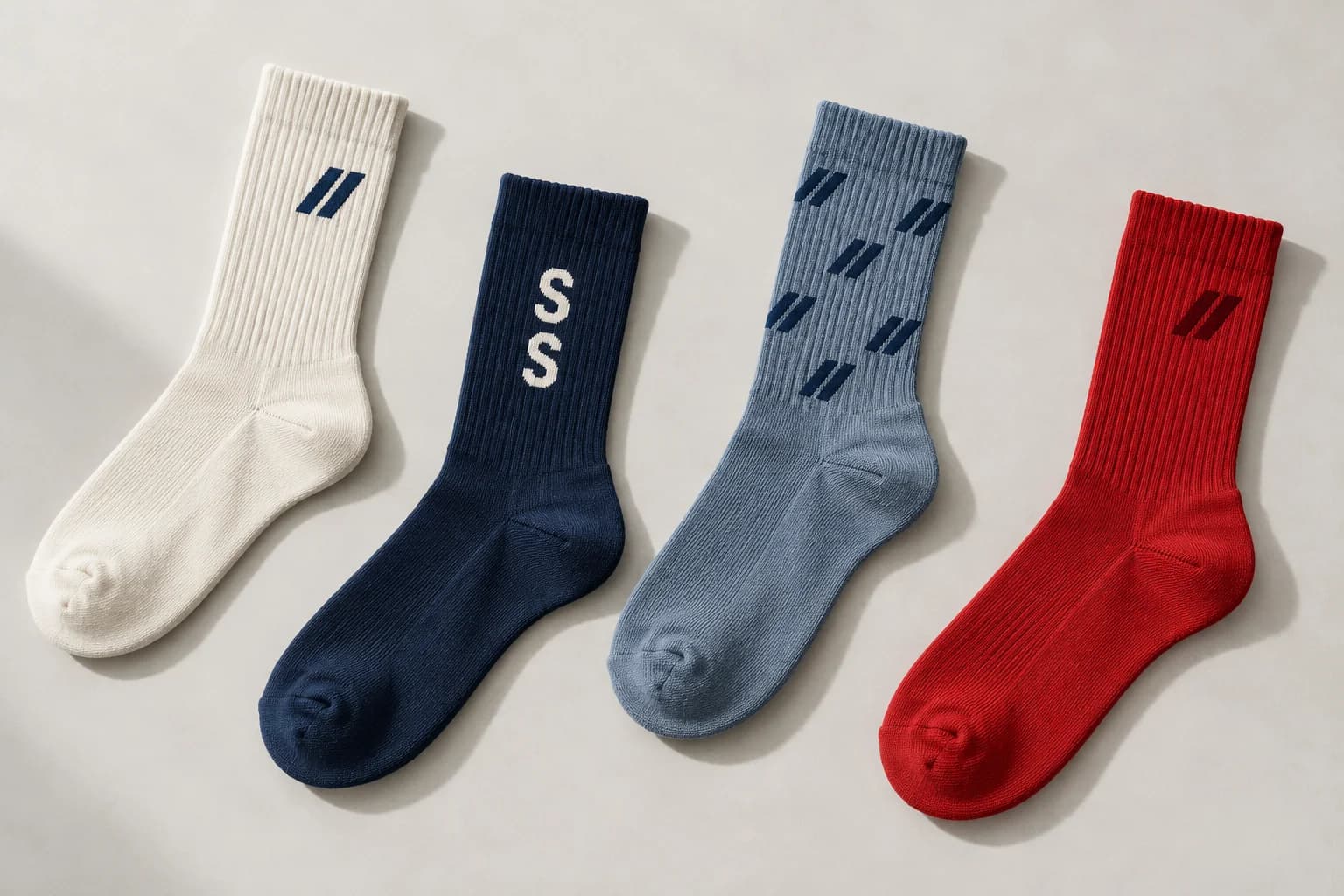
Compare a compact placement with a larger version or more space between the initials. The navy monogram above shows a direction, not a confirmed letter size.
Sample question
Do the initials remain separate and recognizable when the sock is worn? Check the intended leg, cuff or foot position rather than approving an enlarged screen view alone.
A tone-on-tone mark
Direction to compare
Keep the subtle look of the red sock above, or compare a more contrasting yarn color if recognition matters more than discretion.
Sample question
Is the mark visible enough for its intended use under ordinary light? Review the actual yarn colors together; a mockup is not a color approval.
Size and placement can remain undecided when you contact us. Bring your available artwork or describe the idea; we will help work through the sample questions. Feasibility depends on the chosen construction, yarn and sample review, not a universal letter-size promise.
The total pair count is only part of the picture. These choices help us compare a practical starting specification with the options you value.
One design or several?
One design in one size is a different brief from the same total split across designs, colors and sizes. Share the total first; we can help work through the mix.
A simple mark or detailed artwork?
Fine lettering, multiple colors and repeat patterns need different knit-readability checks. Tell us which brand details must stay and which could be simplified.
A paper band or a gift box?
Packaging changes the materials and pack-out work in the quote. We can compare a simpler wrap with a gift presentation rather than assume the most elaborate option.
A fixed date or a flexible window?
An arrival date and destination help us review sampling, approvals and shipment together. Tell us about a fixed event date; timing still needs confirmation.
Have a target budget? Share it if useful, or simply ask us where to start. If you already have a specification, we will work from it. You do not need to decide all four before inquiring; MOQ, price and timing are confirmed only after review.
How can SaySock help make custom logo socks?
We can help review your logo's placement, size and color contrast before it is knitted into the sock. Small lettering or fine details may need simplification; the sample should confirm readability at the intended size. Bring an idea or existing artwork and specifications, and we can work through the options together. Direct Korean production is our first priority.
Logo-led sock programs for merch, gifting, and retail
Review packaging and materials directly with SaySock
North America and Europe buyer support
Tell us about your logo socks.
Share your idea, who the socks are for and any quantity or timing you have in mind. Artwork, packaging and other details can follow.
Uploaded files, mockups, and simulator previews show your design direction; they are not approved production artwork. Production review and sample approval are still needed, and any design work must be scoped separately.
Logo idea, available artwork, reference, annotated mockup or simulator direction
Intended use and any style, placement or color preferences
Approximate quantity, destination and timing, if known
Packaging questions or other details that are still undecided
brand and merch logo program
Compare the closest sourcing paths.
Logo-led custom sock program for brands, merch teams, agencies, retailers, and distributors that need artwork or a rough visual direction translated into a reviewable product, packaging, QC, and shipment brief.
The promotional route connects the branded sock with audience size, distribution, packaging and the intended arrival date.
Logo socks need product context before artwork translation gets expensive.
A logo-led program should define how the mark behaves on a real sock, in a real channel, with a real approval path.
Merch teams turning a mark into a wearable product instead of a disposable giveaway
Agencies and distributors that need clean proofing, packaging, and delivery context
Retail-adjacent programs where logo placement must feel intentional
Translate the mark into knit logic
Vector files help, but the production question is whether the logo should be dominant, repeated, tonal, or secondary.
Confirm the viewing distance
Logo scale changes if the sock is sold on shelf, handed out at an event, or bundled inside a gift kit.
Lock color discipline early
Too many brand colors can weaken knit clarity, MOQ logic, and approval speed.
Brand visibility vs. product credibility
The logo should be visible enough to matter, but not so loud that the sock stops feeling like a usable product.
A starting briefShare what you know so far.A logo sock idea or reference is enough to start an inquiry with SaySock. We review direct production first and clarify missing details; pricing depends on the specification.
A logo idea, reference or existing artwork, if available
Who the socks are for and any style or color preferences
An estimated quantity, destination and timing, if known
Packaging questions, including anything still undecided
Best fitUse custom logo socks when brand placement leads the product.This route works best when the buyer wants a logo-led product that still needs real material, packaging, and shipment decisions around it.
Merch teams and collaborations
Best when the logo is expected to read clearly as a branded merch item rather than a generic promo object.
Retail-adjacent programs
Useful for shop assortments, design stores, and hospitality merch where the logo still has to behave like a product feature.
Gift and campaign kits
Strong when the category needs to feel finished and useful instead of novelty-driven.
Quote questionsAsk about quantity, packaging or timing.MOQ and price are valid starting questions. Estimates depend on the sock specification; you do not need to settle every detail before contacting us.
A rough quantity or the range you are considering
Any packaging preference, target market or sizing question
Your preferred arrival date and whether it is flexible
Sample and pack-outLogo review should stay connected to the sample and packaging path.A stronger logo brief shows what must be proven in the knit sample, what must be visible in packaging, and what has to ship cleanly after approval.
Artwork proofing
An existing file or reference can start the discussion. Artwork, placement, color and scale need review before exact production pricing is confirmed.
Sample review
Use the sample to confirm knit readability, color behavior, product shape, and any logo simplification needed before bulk work.
Packaging handoff
Name whether the logo sock will ship bulk-clean, sleeve-wrapped, tagged, boxed, or kit-ready so pack-out is not decided late.
Buyer decision guideProtect logo clarity without letting artwork swallow the product.A logo sock can become either a cheap giveaway or an overworked knit. Balance the mark, sock body, packaging, and approval path before sampling.
Artwork risk: the logo may not survive knit translation
Review artwork as knit logic rather than treating the mark as an image pasted onto the sock surface.
Best fit: the logo has to behave like a product feature
Use this route when the mark needs scale, placement, yarn color, and packaging decisions around it.
Share your starting point
An idea or reference and intended use can start the conversation. Add quantity, packaging and timing details as they become clearer.
Still exploring?You can start with a logo sock idea, not a finished specification.Tell us who the socks are for and what you want the logo to do. Product, packaging, and timing questions can stay open for the first review.
Share the audience or intended use, even if the sock type is undecided
A rough quantity helps; MOQ and price need a specification review
List packaging, fit, or timing questions you want help resolving
Questions we can work through with your inquiry.
What files are best for custom logo socks?
Vector artwork is best, but a high-resolution reference plus color guidance is enough to start an inquiry with SaySock. We review how the artwork can be knitted before confirming production.
Do I need final artwork before requesting a custom logo socks quote?
No. Start with an available logo file, high-resolution reference, annotated mockup, or simulator draft. In the RFQ, choose file upload, the embedded simulator, or a rough brief; treat every visual preview as directional until production review and sample approval.
Can logo socks also include packaging?
Yes. Sleeves, wraps, tags, and more retail-facing packaging can be scoped alongside the sock so the program does not split into separate supplier tracks.
Are custom logo socks only for promotions?
No. They work across merchandising, gifting, boutique retail, design stores, hospitality programs, and distributor-led brand assortments.
Ready for a production review?
Send the product, quantity band, destination, and what is still undecided.