Start with the front and back of the package
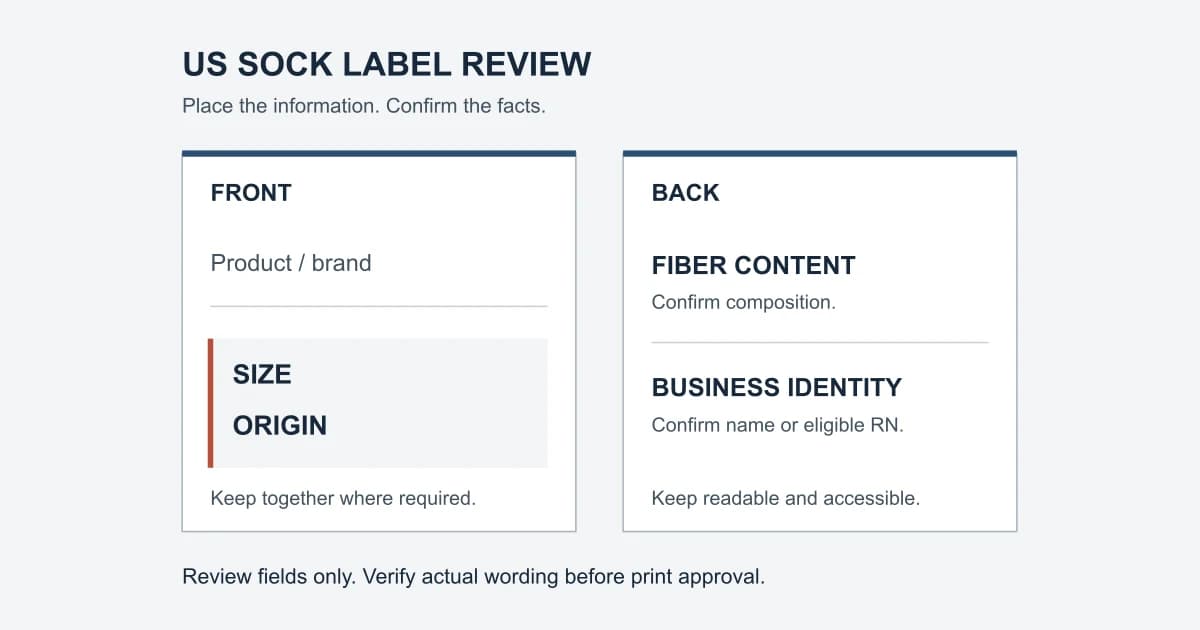
Use this layout to discuss information placement, not as finished artwork. Keep the size and origin area together when the covered-sock rule applies. The back area below is a planning location for other information, not permission to hide it under a fold or seam.
Ask for a flat artwork view and a folded, attached view. Check what a shopper can actually read without opening or damaging the pack. A logo, hanger hole or overlapping band can consume space that looked available in the flat file.
Front of retail pack
Keep these together when the covered-sock rule applies.
Accessible back label
Check readability after folding and attachment.
Give each label field a fact and a confirming person
The table is a review method, not a transfer of legal responsibility. Agree who will supply the information and who can approve its use. A blank field means a decision is open; it is not a reason to invent a plausible value.
| Label field | Evidence to check | Who confirms it | Keep open until confirmed |
|---|---|---|---|
| Fiber content | Actual product composition and supporting production records; use appropriate fiber names. | Production team supplies facts; buyer or responsible US business confirms the proposed wording. | Names, percentages and whether the record covers every item in the pack. |
| Country of origin | Actual manufacturing facts and the origin determination for the goods. | Responsible importer or market owner, with appropriate customs advice where needed. | Country wording and front placement; a Korean office or brand name is not origin evidence. |
| Business identity | The appropriate company name or an eligible RN, verified against the responsible business. | The business whose identity will appear on the label. | Exact identity and authority to use it; do not use a brand logo or invented number as a substitute. |
| Size and pack contents | Agreed size specification and the actual items grouped in this retail pack. | Buyer and production team compare the specification with the packed sample. | Size wording, origin adjacency where applicable, and whether one label describes every item. |
| Artwork version and print approval | The same flat file, attached-package view and agreed approval record. | Named buyer approver and the person releasing the file to print. | Version, unresolved edits and written release; layout review alone is not print approval. |
Check which rule applies to the actual pack
The FTC guide identifies fiber content, country of origin and manufacturer, importer or dealer identity as core information for most covered textiles. Review an appropriate company name or an eligible RN; an RN is not a compulsory number for every label. Other obligations, including care labeling and retailer requirements, need their own check.
16 CFR 303.15(d) applies to the sock tariff subheadings listed there, as in effect on September 1, 2003. It places the English country name on the package front beside size. Confirm coverage for the actual goods rather than applying this diagram to every product.
The packaged-hosiery provision in 303.15(c) is conditional: the goods must reach the consumer in that package, its label must carry the required information, and that information must be equally applicable to each item. The mixed-goods exception in 303.15(d) is limited to that subsection, not a blanket exemption from labeling obligations.
This is a pre-print discussion aid, not a compliance certificate or a complete import guide. Have the responsible US business confirm applicable requirements for the specific product and pack before release.
Separate a useful inquiry from permission to print
For example, a buyer may know the US retail channel and prefer a paper band while the fiber mix and size range are still under review. That is enough to discuss a production brief. It is not enough to authorize printing an unverified composition or origin statement.
First, collect the available facts and mark the rest as open. Next, review the proposed wording and its placement on the actual pack format. Finally, have the agreed approver release the exact file version only after unresolved print decisions are closed. If the sock or pack contents change, reopen the affected fields rather than reusing the old approval automatically.
Use the existing packaging comparison to choose a band, sleeve or tag. Use the importer-record article for the separate importer-identity question. Neither replaces checking the label artwork. You do not need to finish these reviews before asking SaySock about the product you want to make.